A reason to write
I run several projects and only write to people when I know why I am writing to them. The checking that comes first was a job in itself, so I built a system that does it for me and learns from every reply.
I do not send LinkedIn messages in bulk. When I write to someone, I know why I am writing to that person, and I have kept to that rule even now that I run several projects at once. The rule is simple, but it comes at a price. Before a single message goes out, I have to open the profile, read what the person actually does, look up the company they work for and check whether it has anything to do with what I am building.
That takes time, and the time grows with every project. The same person can be irrelevant to a platform for cities and exactly right for a restaurant booking service, so I have to ask the same question once per project. Anyone who skips that check ends up sending everyone the same thing, and on the receiving end that is called spam.
Facts, then a score
I needed a system that would do the check for me and give me two things back. First the facts, with no judgement: who this person is behind the headline, what they do, how big the company is and where it operates. Then how relevant they are to each of my projects, with a sentence explaining why, and without guessing at anything the profile does not say.
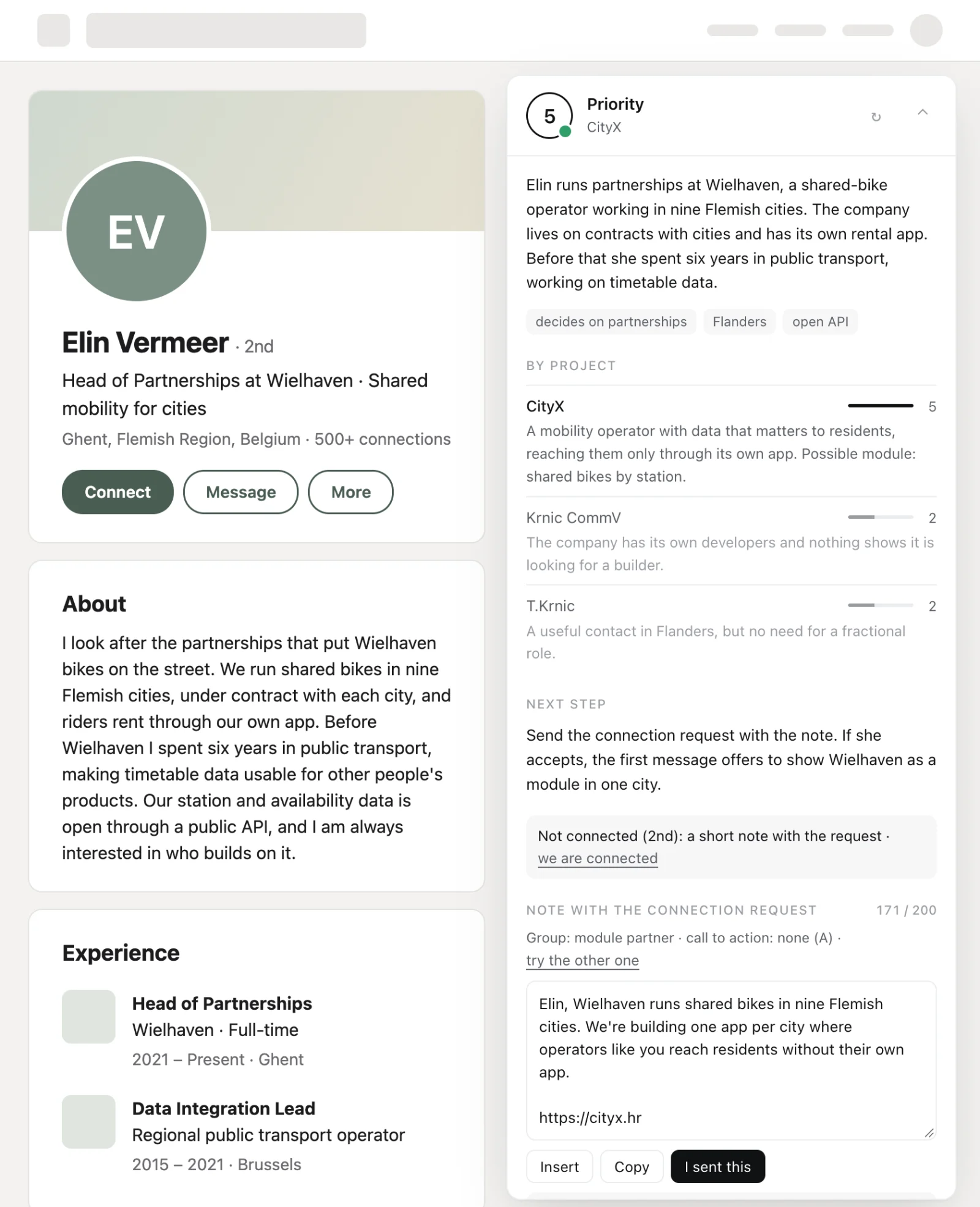
I looked for an existing tool and found none that did this well enough, so I built Krnic Connect. It is a Chrome extension that works while I am looking at a profile: Claude reads what is on the screen and, in one call, returns a short brief and a score for every project. It is strict. Most profiles score low, and for those there is no message.
For the ones that pass, the first contact is already prepared. I get a brief on the person, the reason to write to them and a short draft, with a note pointing to where on the profile the detail it mentions comes from. Connect never sends anything, and it reads only the page I have opened myself. I read the message, edit it and send it myself, because it goes out under my name.
In the lead
Up to this point it would be a human in the loop: the machine proposes, I approve, and tomorrow we do the same again. I have written about that role before, and I do not think it is a good one, because nobody in it improves, neither the tool nor the person. I wanted the opposite: a system in which the agents get better every day, and so do I, the one leading them.
The agents learn from me. When I change a message before sending it, my version is kept as an example of how I write. When I say what bothers me about a draft, that turns into a rule for every message that follows. Each project is described in plain words, who I am looking for and who I am not, so I rewrite the description as soon as I see I have been looking for the wrong people.
I learn from the replies. Every reply is read with one question in mind: what does it tell us about the market, the message or the person? Disagreement is worth as much as agreement. A score based on a profile is an assumption. A conversation is evidence, so the score drops when it turns out the person is not the right one after all. The overview shows which kind of message got replies from which group of people and which led to a meeting, along with a suggestion for what to change, either in the messages or in who I write to.
What I got
I get better replies and I no longer spend time on the wrong contacts. The check is no longer manual, and what I used to carry in my head, who has replied and who is waiting on me, now sits in one place. Daydeck, on my desktop wallpaper, tells me which project is on today. Connect tells me who to write to for it.
I still do not send messages in bulk. The difference is that the rule no longer costs me time, and every reply, even a negative one, makes the next message better.